


Why organisations cannot simply train their way into the future?
Curated By Arvind Kumar
For decades, organisations have relied on a familiar response whenever they identified a capability gap: send people for training. Is yours one of those companies?
Need better leaders? Run a leadership programme. Need greater innovation? Organise a design-thinking workshop. Need digital transformation? Upskill employees.
Training has become the default solution to almost every organisational challenge. Don’t get me wrong, training often a good solution to build capability but certainly not the only go-to ssolutionas the world of work becomes increasingly complex, disrupted and unpredictable, leaders need to confront an uncomfortable truth:
Organisations cannot simply train their way into the future.
Because capability is about far more than what people know. You can teach people agility, but they may return to bureaucratic approval processes. You can train managers to coach, but continue rewarding command-and-control leadership. You can develop innovation skills, but maintain systems where failure is punished.
The issue, therefore, is not always a lack of skills. Sometimes, the organisation itself becomes the biggest barrier to applying those skills.
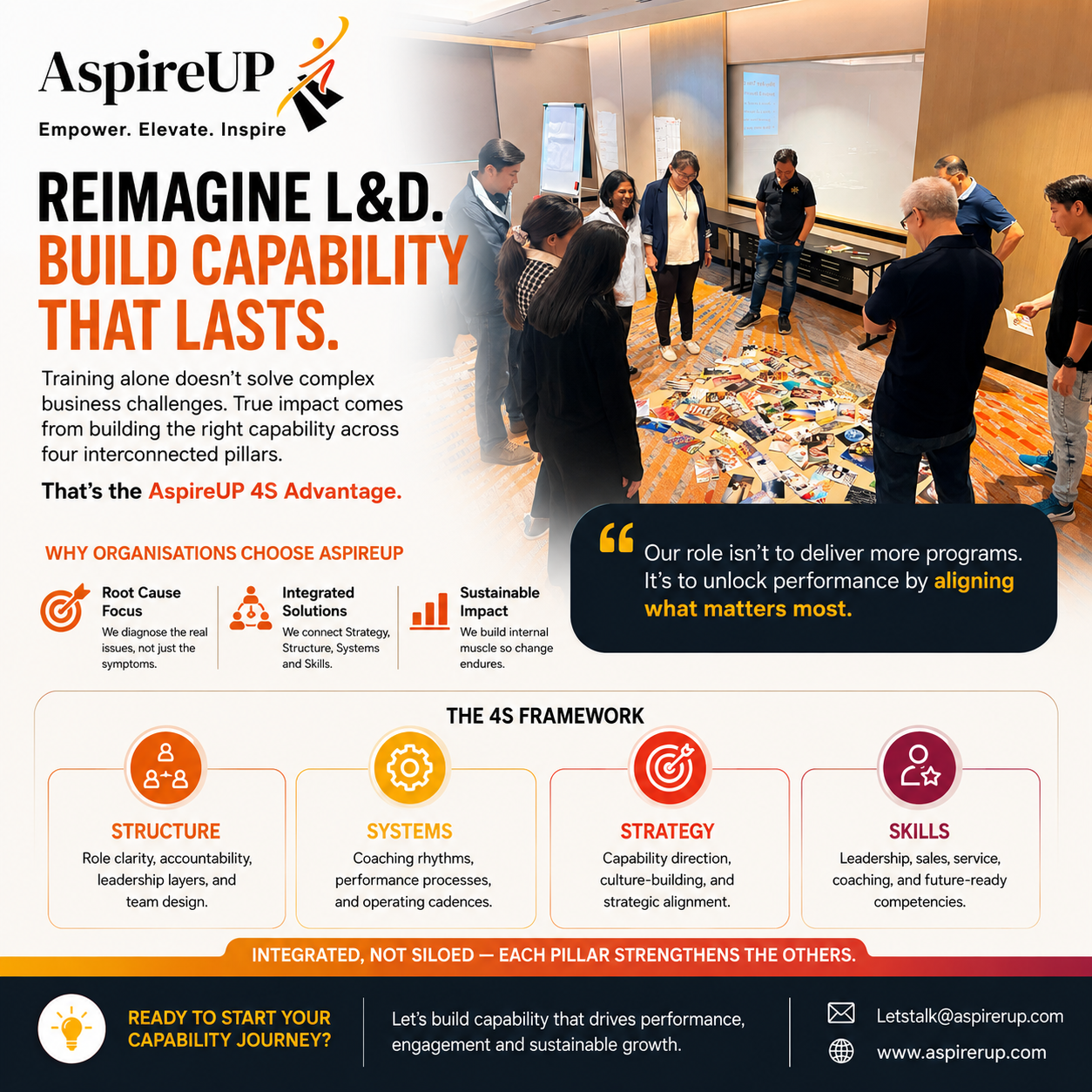
This is why capability building must move beyond training interventions and focus on creating the conditions in which new capabilities can thrive. At AspireUP, we believe future-ready organisations need to examine four interconnected dimensions: Structure, Systems, Strategy and Skills — the 4S Framework.
Future readiness is not something you simply train people for. It is something you intentionally design your organisation to become.
THE TRAINING TRAP
Malaysia has made significant investments in workforce development and skills enhancement. Across industries, organisations are responding to AI, automation, digitalisation and changing workforce expectations by investing heavily in upskilling and reskilling.
This is necessary. Global research, including findings from the World Economic Forum, continues to identify skills gaps as a major barrier to business transformation. Malaysian research similarly points towards the growing importance of digital, analytical and technology-related capabilities.
But there is an important distinction: training activity is not the same as organisational capability.
The number of employees trained, learning hours completed or certifications achieved may tell us something about participation. But it tells us little about whether the organisation is genuinely becoming more capable.
The more important questions are: Has behaviour changed? Has performance improved? Can teams make decisions faster? Are employees applying what they have learned? Have organisational barriers been removed?
The future requires organisations to move from asking, “What training do our people need?” to asking, “What capabilities must our organisation build to remain relevant?”
THE 4S FRAMEWORK
- STRUCTURE: Is Your Organisation Designed for Yesterday or Tomorrow?
Many organisations still operate using structures designed for a different era — one characterised by predictability, clear boundaries and centralised decision-making.
Today, markets move faster, technology evolves rapidly and problems increasingly require collaboration across functions.
Future-ready organisations need structures that enable faster decision-making, cross-functional problem solving, clear accountability and empowered teams. Global best practices increasingly point towards flatter, more networked and agile ways of organising work.
The shift is not about removing hierarchy. It is about creating structures that enable movement rather than restrict it.
You cannot expect people to move at the speed of change when the organisation is built to move at the speed of bureaucracy.
- SYSTEMS: The Organisation Reveals What It Truly Values
Culture is reinforced through systems.
What gets measured. What gets rewarded. Who gets promoted. How decisions are made. How performance is evaluated.
An organisation may say it wants collaboration but reward only individual achievement. It may say it wants innovation but punish failed experiments. It may promote empowerment while requiring multiple layers of approval.
The system will always speak louder than the slogan.
If leaders want different behaviours, they cannot simply communicate them. They need to examine the systems surrounding those behaviours. Future-ready organisations need systems that encourage experimentation, knowledge sharing, continuous feedback, collaboration and learning in the flow of work.
A powerful question for leadership teams is: What systems are reinforcing the behaviours we are trying to change?
- STRATEGY: Capability Building Must Have a Purpose
One of the greatest mistakes organisations make is developing people without sufficient strategic context.
Training calendars are created and programmes launched, but the fundamental question is often overlooked: Capability for what?
Every organisation is moving towards a future. The question is whether its capability investments are aligned to that future.
What markets are we entering? What technologies will disrupt us? What customer expectations are changing? What must we become exceptionally good at?
The connection needs to be clear:
Strategy → Organisational Capability → Workforce Capability → Learning Investment
If AI transformation is strategic, the answer cannot simply be an AI awareness workshop. The organisation may need new operating models, governance, technology infrastructure and leadership capabilities.
Future-ready organisations start with the question: What future are we trying to create? They then build the capabilities required to deliver it.
- SKILLS: From Training Events to Continuous Capability Building
Skills remain critical, but the way we build them must evolve.
Real capability does not develop through information alone. It develops through application, experimentation, reflection, feedback and practice.
Instead of simply asking, “What courses should we offer?”, organisations should ask, “How can people learn while solving real business challenges?”
This includes stretch assignments, cross-functional projects, coaching, peer learning, communities of practice, mentoring and action learning.
The most powerful learning increasingly happens in the flow of work.
Capability building therefore cannot sit solely with HR or L&D. Leaders must become capability builders. Managers must become learning enablers. Teams must become learning communities.
BEYOND TRAINING. TOWARDS TRANSFORMATION.
The real power of the 4S Framework lies in the interconnection between Structure, Systems, Strategy and Skills.
Consider an organisation investing heavily in AI training. Employees become excited and leaders attend workshops. But there is no clear strategy, legacy systems restrict experimentation and teams have no opportunity to apply what they have learned.
The organisation has trained people. But has it built capability?
Now imagine a different approach. The organisation identifies where AI can create strategic value. It establishes cross-functional ownership, redesigns systems to enable responsible experimentation and builds targeted skills across leadership and workforce levels.
Learning now has context. Skills have application. Strategy has execution.
That is the difference between training people and building an organisation capable of transformation.
Malaysia’s next capability challenge is therefore to move beyond measuring training volume towards measuring organisational impact.
The question should no longer be: “How many people did we train?”
It should be: “What are we now capable of doing that we could not do before?”
The future will not belong to organisations with the most training programmes. It will belong to those that can learn, adapt and reinvent themselves faster than the environment around them changes.
The leadership question is no longer simply, “What training should we run?”
It is:
“What kind of organisation must we become?”
And once that question is answered, everything must align behind it.
Structure. Systems. Strategy. Skills.
Because you cannot simply train people for the future if the organisation they return to is still designed for the past.
The future will belong to organisations that do not merely prepare their people for change — but intentionally redesign themselves to embrace it, adapt to it and ultimately shape it.
AK signing off!