


When organisations face a performance problem, the instinctive response is often to ask what people need to learn.
Sales are slowing, so sales training is introduced. Leadership capability is inconsistent, so managers are sent for development programmes. Collaboration is weak, so teams are brought together for workshops designed to improve communication and trust.
These interventions can be valuable. But they also reveal a persistent assumption in organisational development: that performance problems are primarily people problems, and that people problems can be solved through training.
That assumption is becoming increasingly difficult to defend.
As organisations navigate digital transformation, AI adoption, changing customer expectations and new ways of working, the gap between current performance and future readiness is rarely explained by skills alone. In many cases, employees are being asked to demonstrate new behaviours while operating inside structures, systems and management practices that were designed for a different environment.
This creates a fundamental capability problem.
You can train managers to make faster decisions, but if every meaningful decision still requires multiple levels of approval, speed will remain constrained. You can teach employees how to collaborate across functions, but if performance measures continue to reward individual or departmental outcomes, collaboration will remain difficult.
You can invest heavily in digital and AI capability, but if the organisation has not clarified where technology should improve work, decision-making or customer value, those new skills may never translate into meaningful business impact.
The issue, therefore, is not whether training works. The more important question is whether training is addressing the right problem.
Capability Is an Organisational System
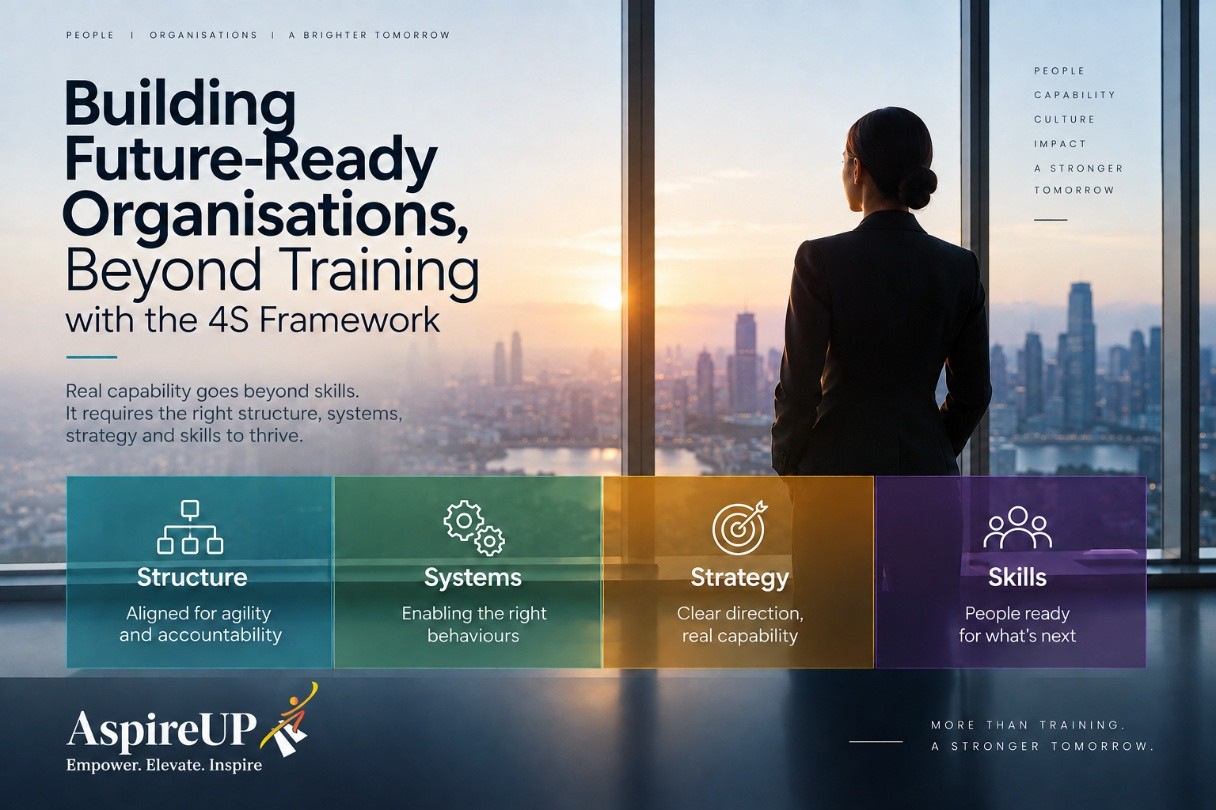
A more useful way to think about capability is to see it as the product of several interconnected organisational conditions. At AspireUP, we describe these through four dimensions: Structure, Systems, Strategy and Skills.
Together, they form what we call the 4S Framework.
The framework is based on a simple premise: people perform within an organisational environment. If that environment does not support the behaviours and capabilities the organisation is trying to build, learning interventions will have limited impact.
The first dimension is Structure.
Organisations should examine whether roles, reporting relationships, decision rights and accountability mechanisms are still aligned with the way the business now needs to operate.
Structures often evolve more slowly than strategy. Organisations may aspire to become more agile, customer-focused or innovative while retaining hierarchical decision-making models that discourage ownership and slow execution.
In those situations, the gap is not primarily a skills gap. It is a structural one.
The second dimension is Systems.
Every organisation has formal and informal systems that shape behaviour: performance management, technology, workflows, incentives, coaching routines, meetings, information flows and operational processes. These systems often have a greater influence on behaviour than training does.
An organisation may encourage experimentation while punishing mistakes. It may promote empowerment while requiring excessive approvals. It may teach managers to coach while performance conversations remain dominated by targets and compliance.
When systems send signals that contradict the behaviours taught in training, employees will usually follow the system.
The third dimension is Strategy.
Many capability programmes begin with a list of competencies. A better starting point is the organisation’s strategic direction.
What must the organisation become better at over the next three to five years? What capabilities will differentiate it? What behaviours will leaders and employees need to demonstrate more consistently? And which capabilities will become less important as technology changes the nature of work?
Without this connection, capability development can easily become a collection of programmes rather than a deliberate investment in future performance. Only then should leaders turn to the fourth dimension: Skills.
Skills remain essential. Employees will need to continuously learn, unlearn and relearn as AI, automation and changing business models reshape jobs. But skills development becomes significantly more powerful when it is supported by the right structures, systems and strategic clarity.
The Role of L&D Must Change
This has important implications for Learning and Development. For many years, L&D has been evaluated largely by the quality of programmes delivered, participation rates and learner feedback.
A future-ready capability function needs to play a different role. Rather than beginning with the question, “What training should we provide?”, L&D leaders should increasingly begin with, “What is preventing the organisation from performing differently?”
That requires stronger diagnostic capability and closer partnership with business leaders. Sometimes the answer will be a learning intervention. At other times, the problem may require redesigning a process, clarifying decision rights, changing performance measures, strengthening management routines or translating strategy more clearly into expected behaviours.
This also means business leaders cannot outsource capability building to L&D. If the performance barrier sits within structure, systems or strategy, ownership must sit with the business.
The strongest capability functions will therefore not simply deliver learning. They will help the organisation identify where capability really breaks down and bring the right stakeholders together to address it.
Ask a Different Question
Before launching the next training programme, leaders may benefit from asking four questions.
- Is our structure enabling the behaviours we expect?
- Are our systems reinforcing those behaviours?
- Is our strategy clear enough for people to understand what capabilities matter most?
- And finally, do our people have the skills required to deliver?
That sequence matters. Because organisations cannot train their way around unclear accountability, inefficient processes, conflicting incentives or poorly translated strategy.
Training can strengthen people but building a future-ready organisation requires something broader. It requires creating an environment in which people are able to use what they learn. That is no longer simply an L&D challenge, it’s a leadership challenge.