


Why strategy often loses momentum after the leadership meeting
Strategy is rarely the problem. The harder challenge is turning leadership intent into clear priorities, everyday decisions and consistent behaviour across the organisation.
Most organisations do not struggle because they have no strategy. In fact, many leadership teams invest significant time discussing priorities, reviewing performance, identifying opportunities and agreeing on the direction the organisation needs to take. The challenge often begins after that conversation ends.
A strategy may be clear in the boardroom, but that does not automatically mean it is clear to the people expected to execute it. Somewhere between leadership discussions, management briefings and daily operations, important parts of the message can become diluted. Employees may understand what the organisation wants to achieve, but they may not fully understand what that means for the work they do every day.
This is where many execution gaps begin.
Leaders discuss the strategy. Managers receive the presentation. Teams are informed about the priorities. And then, consciously or unconsciously, everyone is expected to make the strategy happen.
The problem is that communication alone does not create execution.
Employees need more than information. They need clarity. They need to understand what the strategy means for them, what they are expected to do differently and how their work contributes to the larger outcome.
When that clarity is missing, people naturally fall back on what they already know. They continue with familiar routines, familiar priorities and familiar ways of working. The organisation may have introduced a new strategy, but the behaviour of the organisation remains largely unchanged.
| “Do our people know what they need to do differently because of the strategy?” |
This is why one of the most important questions leaders should ask is not simply, “Have we communicated the strategy?” A more useful question is whether people know what they need to do differently because of it.
That distinction matters. A strategy may call for greater customer focus, stronger collaboration, increased productivity or faster growth. These may all be important strategic priorities, but they remain broad concepts until someone translates them into action.
If improving customer experience is a priority, what should employees do differently when speaking with customers? If collaboration is a priority, what behaviours need to change across functions? If productivity is the goal, which activities should teams stop doing, start doing or approach differently?
Strategy becomes useful when people can connect it to real decisions and behaviours.
The manager is the bridge
This is where managers play a particularly important role. Senior leaders may define the direction of the organisation, but managers are often the people who make that direction real. They sit between organisational ambition and operational reality. They understand the priorities coming from leadership, but they also understand the pressures, challenges and constraints their teams face every day.
Their responsibility is therefore not simply to repeat the strategy. Their responsibility is to translate it.
Good managers help their teams understand what broad organisational priorities mean in practical terms. They take concepts that may feel distant or abstract and convert them into expectations that people can understand and act on.
For example, telling a team that the organisation wants to “improve customer experience” may create awareness, but it does not necessarily create action. A stronger conversation might be: “For our team, improving customer experience means reducing unnecessary handovers, resolving more issues at the first point of contact and identifying recurring problems that we can remove.”
The strategy has not changed. What has changed is the team’s ability to understand what it means.
| A PRACTICAL LEADERSHIP TEST
Before communicating any major strategic priority, ask: “What should my team be doing differently on Monday because of this?” If the answer is not clear, the strategy is probably not yet ready to be cascaded. |
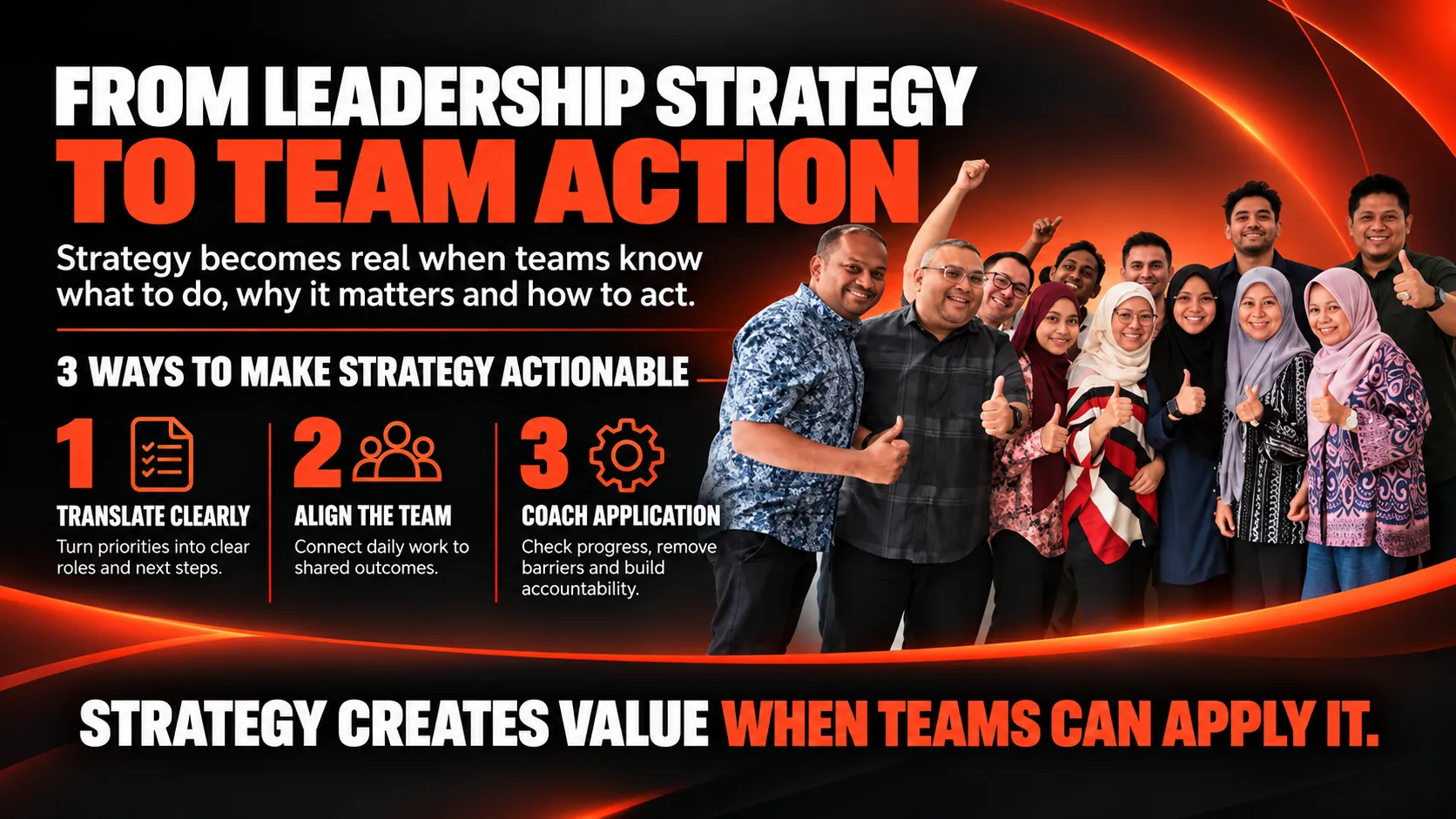
This is the first step in turning strategy into action: translate clearly.
Alignment turns direction into ownership
The second step is alignment. People are more likely to take ownership of a strategy when they can see how their contribution connects to the bigger picture. This connection is often missing in organisations where employees are given targets and tasks without fully understanding how those activities support wider business priorities.
Alignment helps employees understand not only what they need to do, but why it matters.
When people can see the relationship between their work, their team’s performance and the organisation’s goals, they are better positioned to make decisions. They can prioritise more effectively. They can challenge activities that no longer add value. And they can respond more confidently when circumstances change.
This becomes especially important when teams are already managing multiple priorities. Most organisations do not suffer from a shortage of initiatives. The problem is often the opposite. Employees are asked to focus on several things at the same time, all of which appear important.
Without clear alignment, everything becomes a priority. And when everything becomes a priority, teams often struggle to identify what really matters.
One of the most useful things a leader can do is reduce that noise. Instead of asking teams to chase ten priorities, identify the two or three outcomes that matter most and make the connection between those outcomes and the strategy explicit.
This gives teams a clearer basis for making trade-offs. It also helps them answer a more useful question: “Does this activity move us closer to the outcome we are trying to create?”
Leaders therefore need to help employees make those connections. What are the few outcomes that matter most? Which activities directly support those outcomes? Where should the team focus its time, energy and attention?
This is not about simplifying the strategy to the point where it loses meaning. It is about making the strategy relevant enough for people to apply it.
Coach the application, not only the result
The third step is where execution either gains momentum or begins to fade: coaching the application.
Even when people understand the strategy and know what they are expected to do, change rarely happens perfectly from the beginning. Teams will face challenges. Processes may get in the way. People may require new skills. Some employees may understand the expectation but lack confidence in applying it. Others may need feedback to adjust their approach.
This is why implementation cannot end with the initial briefing. Leaders need to stay close to the work.
That means having regular conversations about progress, challenges and application. What are we seeing? What is working? Where are we getting stuck? What is making execution difficult? What support do people need?
These conversations should not become another layer of reporting. Their value lies in helping people think, adapt and move forward.
A useful shift is to coach the execution, not only the result. Instead of asking only, “Did we hit the target?”, leaders can also ask: What is working? What is getting in the way? What support or decision is needed?
Those questions surface the real barriers to execution far earlier than a performance report often will.
Diagnose before you demand
It is also where leaders need to resist a common temptation. When execution slows down, the instinct is often to apply more pressure. Set tougher targets. Increase monitoring. Ask for more updates. Push teams harder.
Sometimes that may be necessary. But pressure does not solve every execution problem.
If the issue is unclear expectations, more pressure will not create clarity. If the problem is a broken process, increased monitoring will not remove the obstacle. If employees lack capability, tighter deadlines will not automatically build competence.
Effective leaders diagnose before they demand.
Sometimes teams need clearer direction. Sometimes they need faster decisions. Sometimes they need coaching. Sometimes they need barriers removed. And sometimes leaders need to change the system rather than asking people to simply work harder within it.
Strategy must eventually become behaviour
Ultimately, strategy only creates value when it changes behaviour. It should influence how decisions are made, how priorities are set, how managers lead, how teams collaborate and how employees respond to customers.
If the strategy changes but the behaviour of the organisation remains the same, then very little has actually changed.
This is why execution should not be treated as the final stage of strategy. Execution is the point where strategy becomes real.
| BEFORE CLOSING THE NEXT LEADERSHIP MEETING
• What will our teams do differently because of this strategy? • What could get in the way of that behaviour changing? • How will our managers coach and reinforce the application? |
And perhaps the most practical question of all: Does our team know exactly what this strategy means for them on Monday morning?
Because strategy does not create value simply because leaders have agreed on it. It creates value when people across the organisation understand it, connect with it and apply it in the work they do every day.
The real work of strategy begins after the leadership meeting.
Translate it. Align the team. Coach the application.