


Why Great Strategies Fail — and What Leaders Can Do About It
Curated Arvind Kumar
Your strategy isn’t failing. Your execution might.
The Growing Concern Among CEOs
It’s an uncomfortable truth many leaders would rather avoid.
Most organisations do not suffer from a lack of strategic planning. They invest significant time and resources in annual strategy retreats, leadership offsites, market analyses, and transformation roadmaps.
Yet despite having well-crafted strategies, many organisations continue to struggle with growth, innovation, productivity, and customer experience.
The question is not whether organisations have a strategy.
The question is whether they can execute it.
The Growing Concern Among CEOs —What’s The Evidence?
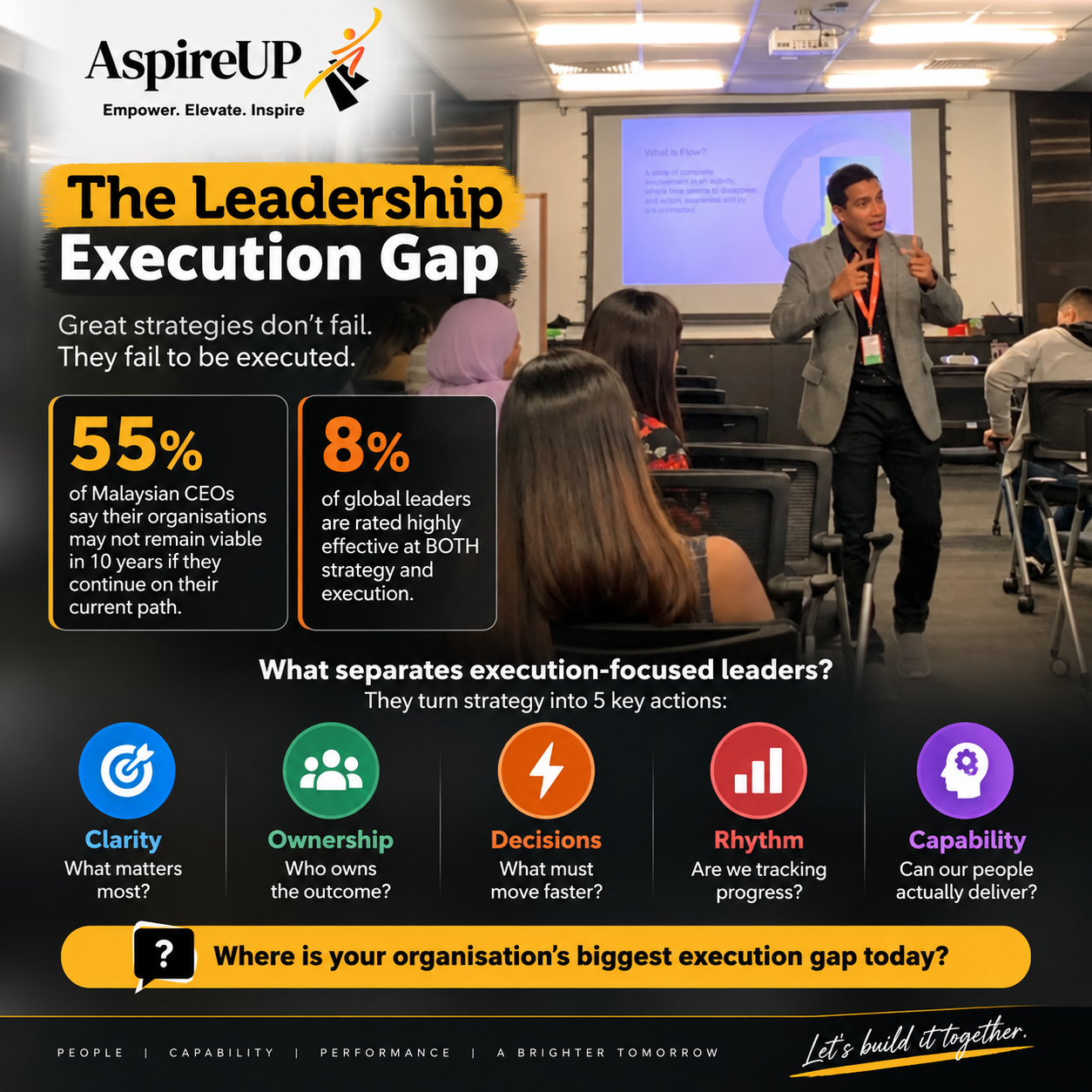
According to PwC’s Global CEO Survey, more than half of CEOs believe their organisations will not remain economically viable over the next decade if they continue operating as they do today.
Closer to home, Malaysian business leaders are facing similar challenges:
- Rapid technological disruption
- Talent shortages and changing workforce expectations
- Increasing customer demands
- Economic uncertainty and geopolitical volatility
- Pressure to innovate faster while maintaining operational excellence
Many organisations know where they want to go.
Far fewer know ‘how’ to get there consistently.
The Leadership Execution Gap
Research by leadership consultancy firms have consistently shown that strategy execution remains one of the greatest leadership challenges globally.
A frequently cited finding from leadership studies suggests that only a small percentage of leaders are highly effective at both developing strategy and executing it successfully.
Why?
Because strategy and execution require different leadership capabilities.
- Strategy answers:
Where are we going?
Why does it matter?
What opportunities should we pursue?
- Execution answers:
Who will do what?
By when?
How will progress be measured?
What obstacles must be removed?
Many leaders excel at vision. Fewer excel at translating vision into action.
And that is where the execution gap begins.
The Hidden Cost of Poor Execution
When execution breaks down, organisations experience:
Strategic Drift — Employees become busy but not necessarily productive. Teams work hard but often on competing priorities.
Initiative Overload — New projects are launched before existing initiatives are embedded. People become overwhelmed and confused about priorities.
Slow Decision-Making — Opportunities are missed because decisions take too long or ownership is unclear.
Reduced Accountability — Everyone is responsible, which often means no one is accountable.
Employee Disengagement — People lose confidence when strategies change frequently or when leadership messages fail to translate into meaningful action.
What Separates Execution Leaders?
From our leadership development interventions across industries, we’ve observed that leaders who consistently deliver results focus on five critical areas.
1. Clarity: What Matters Most?
Execution begins with focus.
Leaders often communicate too many priorities, creating confusion throughout the organisation.
- Execution leaders simplify complexity by clearly defining:
The top strategic priorities
Success measures
Expected behaviours
Key outcomes
Their teams know exactly what winning looks like.
As management thinker Peter Drucker famously said: “If you have six priorities, you have no priorities.”
2. Ownership: Who Owns the Outcome?
One of the biggest execution killers is ambiguous accountability.
- Execution leaders ensure every strategic initiative has:
A clearly identified owner
Defined responsibilities
Decision-making authority
Measurable outcomes
Ownership creates commitment.
Without ownership, initiatives become discussions rather than results.
3. Decisions: What Must Move Faster?
Research by McKinsey suggests that organisations with faster and higher-quality decision-making tend to outperform peers significantly.
Execution leaders understand that speed matters.
- They reduce bureaucracy by:
Clarifying decision rights
Empowering frontline leaders
Eliminating unnecessary approvals
Encouraging calculated risk-taking
In today’s environment, slow decisions are often more costly than imperfect decisions.
4. Rhythm: Are We Tracking Progress?
Strategy should not be reviewed once a year.
Execution leaders create a rhythm of accountability.
- This includes:
Weekly operational reviews
Monthly performance discussions
Quarterly strategic checkpoints
Real-time dashboards and metrics
What gets measured gets managed.
More importantly, what gets discussed gets attention.
Execution is sustained through disciplined follow-through.
5. Capability: Can Our People Deliver?
Many organisations assume people can execute simply because they understand the strategy.
Understanding is not capability.
- Execution leaders invest heavily in building:
Leadership capability
Decision-making skills
Coaching effectiveness
Collaboration skills
Change agility
Digital and AI literacy
They recognise that strategies succeed only when people possess the skills required to deliver them.
Global Best Practices in Closing the Execution Gap
Leading organisations around the world have adopted several practices to strengthen execution.
Align Strategy with Daily Work
High-performing organisations ensure every employee can connect their work directly to strategic goals. People understand not only what the strategy is but how their role contributes to it.
Build a Culture of Accountability
Execution-focused cultures reward outcomes, learning, and ownership rather than activity alone.
Develop Leaders at Every Level
Execution is not solely the responsibility of senior management. Middle managers and frontline leaders play a critical role in translating strategy into operational reality.
Focus on Fewer Priorities
Successful organisations resist the temptation to pursue too many initiatives simultaneously. They concentrate resources on a small number of high-impact priorities.
Measure Leading Indicators
Rather than focusing only on lagging indicators such as revenue and profit, execution leaders monitor behaviours and activities that predict future success.
The Leadership Question Every Organisation Must Answer
Most organisations spend considerable time asking:
“Do our people understand the strategy?”
A more powerful question is:
“What are our people doing differently because of. it?”
Because strategy is only valuable when it changes behaviour.
When teams make better decisions, collaborate more effectively, focus on the right priorities, and consistently deliver outcomes, strategy becomes reality.
That is where execution happens.
And that is where leadership matters most.
My Final Reflection
The greatest competitive advantage today may not be having a better strategy.
It may be executing better than everyone else.
Strategy creates direction.
Execution creates results!
The organisations that thrive over the next decade will not necessarily be those with the boldest visions.
They will be those whose leaders can consistently turn vision into action, action into results, and results into sustained performance.
So, hand on heart leaders:
Where is your organisation’s biggest execution gap?