


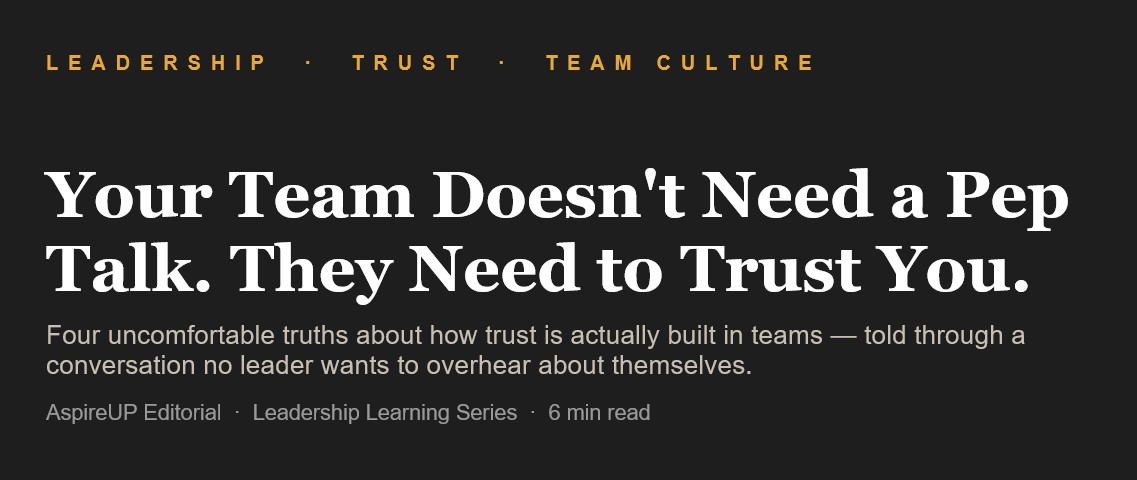
There is a particular kind of leadership delusion — and most leaders have had it at least once. It goes like this: “My team knows I trust them. I said so in the all-hands.” Meanwhile, the team is on a Slack thread titled “you won’t believe what he did now,” and the words “trust” and “your leader” are not appearing together in any sentence.
Trust is not a policy. It is not a declaration. It is not even a workshop — though a good workshop can help you understand why yours is broken. Trust is a pattern of behaviour, accumulated over time, that tells people: you are safe here, you are seen here, and what you do here matters.
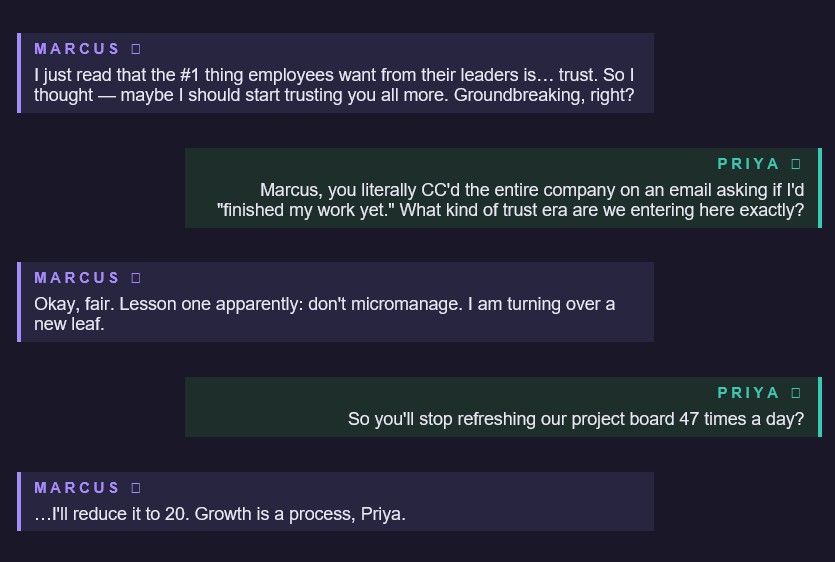
We dramatised this tension in a conversation between Marcus — a well-meaning team lead who has been accidentally dismantling his team’s trust for months — and Priya, his sharpest senior, who has been quietly keeping score. What came out of that exchange maps almost perfectly onto four evidence-backed pillars of trust that every leader can act on today.
| 58%
of employees say they trust a stranger more than their own boss |
27%
productivity gain in teams with high psychological safety |
76%
of employees with trusted managers are more engaged at work |
| 🔓 | Pillar One
Autonomy: Stop Watching and Start Trusting |
Marcus admitted — under some pressure — that he refreshes his team’s project board close to fifty times a day. He is not unusual. Micromanagement is one of the most common trust-killers in modern workplaces, and it is almost always well-intentioned. Leaders who micromanage typically do so because they care about outcomes. The irony is that the behaviour communicates the opposite of trust: I don’t believe you’ll get this right without me watching.
True autonomy is not the absence of standards. It is the presence of clear expectations, followed by the genuine freedom to meet them in the employee’s own way. Research from Gallup consistently shows that autonomy — the sense that people own their work — is one of the top predictors of engagement, retention, and performance.
| Micromanagement is like driving with a parking brake on . It signals to your team that their judgement is not enough — and they will believe you.
— Arvind Kumar |
The practical shift: replace check-ins designed to verify with check-ins designed to unblock. Ask “what do you need from me?” instead of “where are you on this?” The first builds trust. The second erodes it, one refresh at a time.
| 🛡️ | Pillar Two
Psychological Safety: Make It Safe to Be Human |
Google’s Project Aristotle — one of the most comprehensive studies of team effectiveness ever conducted — found that psychological safety was the single biggest predictor of high-performing teams. Not talent. Not resources. Not strategy. Safety: the belief that you can speak up, push back, take a risk, or admit a mistake without being punished for it.
Leaders create — or destroy — this environment through their own behaviour. When a leader punishes bad news, ridicules a question, or plays the infallible expert, they send a clear signal: protect yourself here, not your ideas. The team responds rationally: they go quiet, stay safe, and do only what is necessary to survive.
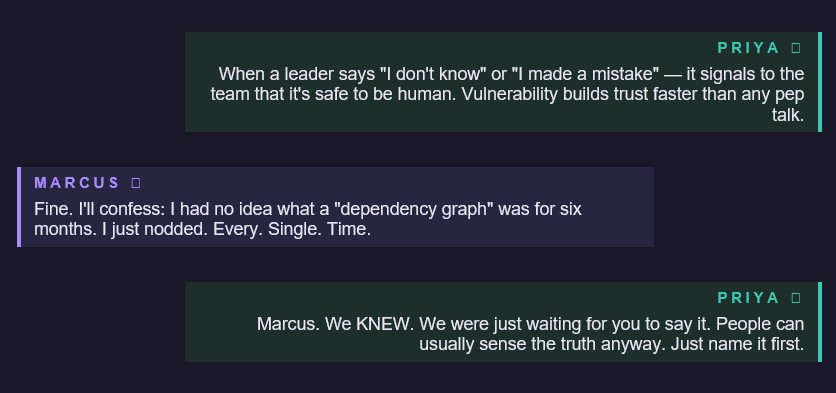
The fastest way to build psychological safety? Model the very vulnerability you want to see. When Priya told Marcus that his team had known for months that he didn’t understand what a dependency graph was, and had just been waiting for him to say so — that moment perfectly illustrates how safety works.
Psychological safety is not about being soft. It is about being honest. Teams with high safety do not avoid hard conversations — they have them earlier, more directly, and with better outcomes. The leader’s job is to make the first move.
| 🔍 | Pillar Three
Transparency: Say the Thing You’re Hoping They Won’t Notice |
There is a persistent leadership myth that withholding difficult information protects people. In practice, it does the opposite. Teams are remarkably good at reading context — they pick up on shifts in tone, in body language, in what is conspicuously not said.
Transparency is not radical honesty delivered without care. It is the disciplined practice of sharing relevant information — even when it’s uncomfortable — with appropriate context and timing. It means naming the difficulty before someone else names it for you, explaining the reasoning behind decisions, and acknowledging when you don’t yet have an answer rather than performing certainty you don’t possess.
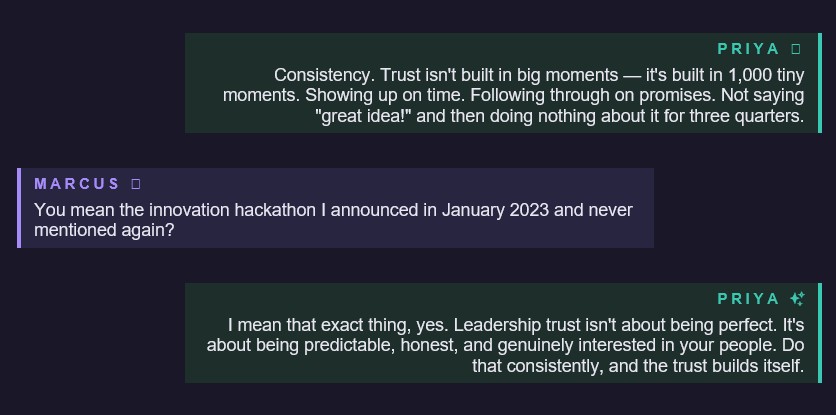
The abandoned hackathon Marcus promised his team in January 2025 is a small thing. But small things compound. Every unfollowed-through commitment is a small withdrawal from the trust account — and most leaders don’t realise how overdrawn they are until the account is empty.
| Transparency is not about sharing everything. It’s about never letting your team be surprised by something you already knew.
— AspireUP Quote |
| ⏱️ | Pillar Four
Consistency: Trust Is Built in the Boring Moments |
This is the one leaders least want to hear, because it contains no shortcut. Trust is not built in the keynote address, the team-building offsite, or the heartfelt one-to-one. Those moments matter — but they don’t accumulate trust on their own. Trust is built in the compounding of a thousand small interactions where the leader did exactly what they said they would do.
Starting the meeting on time. Following up after someone flagged a concern. Remembering what a team member said they were working toward. Giving credit publicly and consistently. None of these are dramatic. All of them register.
Consistency also applies to how leaders behave under pressure. A leader who is warm and available when things are going well but cold and defensive when things are hard is not a trustworthy leader — they are an unpredictable one. Unpredictability is to trust what kryptonite is to Superman.
| 🧭 The Four Pillars — In Practice
→ Replace surveillance check-ins with unblocking ones. Ask “what do you need?” not “where are you on this?” → Admit a gap in your knowledge this week — in public. Watch what it does to the room. → Name the difficult thing before your team has to. Transparency beats spin every time. → Audit your unfollowed-through commitments. Pick one. Follow through on it today. |
Trust is not a leadership trait you are born with or a culture initiative you roll out in Q3. It is a practice. And like any practice, it is available to every leader who is willing to be a little more honest, a little less controlling, and a lot more consistent than they were yesterday.
Marcus and Priya’s conversation ends with a simple formulation that is worth remembering: leadership trust isn’t about being perfect. It’s about being predictable, honest, and genuinely interested in your people. That is it. That is the whole thing. Everything else is commentary.