


Feedback is one of the most powerful leadership tools we have.
Yet, in many workplaces, feedback is either delayed, avoided, or only given when something has already gone wrong. By that point, the conversation becomes heavier than it needs to be.
- The employee feels judged.
- The leader feels uncomfortable.
- And the opportunity for real growth is often missed.
Constructive feedback should not be about fault-finding. It should be about creating clarity. It helps people understand what is working, what needs to change, and what better performance looks like. When done well, feedback builds trust, improves accountability, and helps people take ownership of their growth.
But feedback alone is not enough, this is where the coaching loop matters.
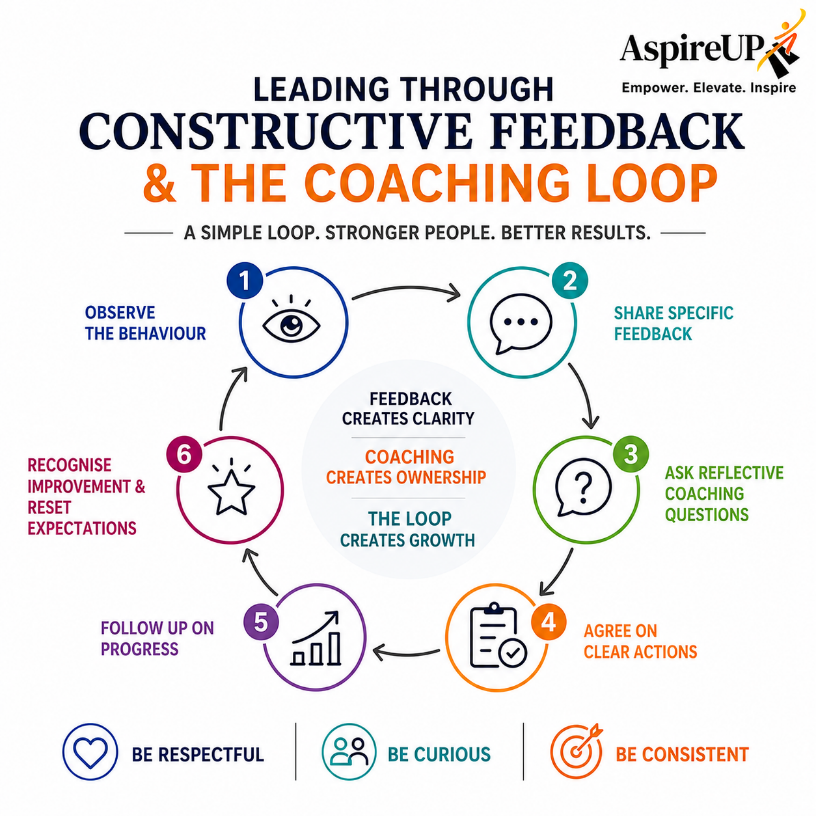
The coaching loop turns feedback from a one-time conversation into an ongoing leadership rhythm. It creates a simple structure where leaders observe behaviour, share specific feedback, ask reflective coaching questions, agree on clear actions, follow up on progress, and recognise improvement.
This is how feedback moves from conversation to action. Many leaders make the mistake of thinking that once feedback has been given, their job is done. In reality, feedback opens the door. Coaching helps the person walk through it.
A strong feedback and coaching loop can look like this:
- Observe the behaviour
Leaders must be present enough to notice what is really happening. Not assumptions. Not hearsay. Actual behaviour. - Share specific feedback
Feedback must be clear, timely, and focused on behaviour and impact. The goal is not to attack the person, but to help them see what needs to shift. - Ask reflective coaching questions
This is where ownership begins. Questions like “What got in the way?”, “What would you do differently next time?”, and “What support do you need?” help people think instead of simply receiving instructions. - Agree on clear actions
Feedback without action becomes just another conversation. Leaders and team members must agree on one or two practical next steps. - Follow up on progress
Follow-up shows that the conversation mattered. It keeps momentum alive and allows leaders to support, remove roadblocks, and reinforce expectations. - Recognise improvement and reset expectations
Progress must be acknowledged. Recognition builds confidence. Resetting expectations keeps growth moving forward.
- This loop is simple, but it requires discipline.
- Leaders need the courage to speak honestly.
- They need the empathy to do it respectfully.
- They need the patience to coach.
- And they need the consistency to follow through.
Constructive feedback should not only happen during performance reviews. It should be part of everyday leadership. A quick check-in after a meeting. A short conversation after a client interaction. A reflection after a project milestone.
These small moments create big shifts. When feedback becomes timely and normal, people stop fearing it. They begin to see it as part of learning.
And when coaching becomes consistent, people stop waiting to be told what to do. They begin thinking, reflecting, and taking ownership. That is the difference between managing performance and developing people.
DINESH KARNA