


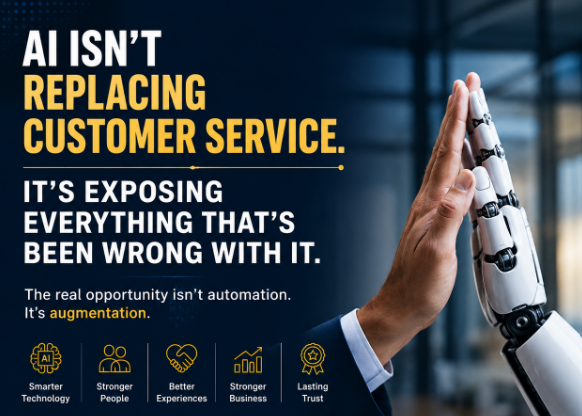
Artificial intelligence is rapidly becoming embedded in nearly every aspect of customer interaction. From conversational chatbots and intelligent routing to predictive analytics and generative AI, organisations are investing heavily in technologies designed to improve speed, reduce costs, and personalise service.
Yet amid this wave of innovation, many executives are confronting an unexpected reality: despite increasing investment in AI, improvements in customer experience are often incremental rather than transformational.
The explanation is straightforward. Most AI initiatives optimise processes. Relatively few redesign the customer experience itself.
This distinction matters.
Customer experience has never been determined solely by operational efficiency. It is shaped by how customers perceive an organisation across every interaction, particularly during moments of uncertainty, complexity, and emotional significance. These are precisely the moments where technology alone has limitations.
As Malaysia accelerates its digital transformation agenda, organisations have an opportunity to rethink the relationship between artificial intelligence and human capability. The question is no longer whether AI should be adopted. The more important question is how AI can elevate human performance rather than simply automate human work.
The Shift from Automation to Augmentation
The first generation of AI adoption focused largely on automation.
Routine enquiries could be answered automatically. Transactions became self-service. Administrative tasks were completed faster and at lower cost.
These developments delivered measurable operational benefits. However, automation reaches diminishing returns when customer needs become more nuanced.
Consider a customer disputing an unexpected financial transaction, a patient seeking clarity about medical procedures, or a business client managing a critical supply chain disruption. In each situation, the customer requires more than information. They require judgement, reassurance, and confidence.
These interactions reveal the limits of automation and highlight the value of augmentation.
AI augmentation differs fundamentally from automation. Rather than replacing employees, it enhances their ability to make informed decisions, retrieve knowledge rapidly, anticipate customer needs, and focus attention where human judgement creates the greatest value.
The objective shifts from reducing human involvement to increasing human effectiveness.
Customer Experience Begins with Employee Experience
Many organisations continue to view customer experience as an external capability. In practice, it is largely an internal one.
Employees cannot consistently deliver exceptional experiences while navigating fragmented systems, disconnected information, and repetitive administrative work.
This is where AI has the potential to create its greatest impact.
Imagine frontline employees who receive real-time recommendations based on customer history, instant access to relevant policies, automated summaries after every interaction, and intelligent prompts that guide complex conversations.
The technology itself is not the competitive advantage.
The competitive advantage lies in what employees are then able to do with the time, clarity, and confidence that technology provides.
Organisations that strengthen employee capability often discover that customer satisfaction improves as a natural consequence rather than a separate initiative.
The Emerging Leadership Challenge
AI transformation is frequently treated as a technology programme. Increasingly, it should be viewed as a leadership challenge.
Technology adoption can be mandated. Trust cannot.
Employees must understand not only how to use AI, but why it exists within their workflow. Without this clarity, AI risks being perceived as surveillance, replacement, or additional complexity rather than meaningful support.
Leaders therefore face a dual responsibility: investing in technology while cultivating confidence, capability, and adaptability across their workforce.
This requires moving beyond implementation plans toward organisational learning.
The organisations that will benefit most from AI are unlikely to be those with the largest technology budgets. They will be those that most effectively integrate technology with leadership, culture, and continuous capability development.
A Malaysian Perspective
Malaysia occupies a distinctive position within Southeast Asia’s digital economy.
Its multicultural workforce, multilingual capabilities, and growing digital infrastructure provide a strong foundation for AI-enabled customer experience. At the same time, Malaysian consumers continue to place significant value on relationships, trust, and personalised service.
This creates an important strategic implication.
Success will not come from replicating technology-led customer experiences developed elsewhere. It will come from designing experiences that reflect both technological sophistication and local expectations of human interaction.
In this context, AI should not be viewed as a substitute for service excellence. It should be viewed as an accelerator of it.
Three Strategic Questions for Leaders
As organisations continue their AI journeys, three questions deserve greater attention.
First, where in the customer journey does human judgement create disproportionate value, and how can AI strengthen rather than replace it?
Second, are current AI investments reducing customer effort, employee effort, or both?
Finally, how will leadership evolve to build trust in an organisation where humans and intelligent systems increasingly work together?
These questions move the conversation beyond technology implementation toward organisational transformation.
Looking Forward
The next phase of customer experience will not be defined by artificial intelligence alone.
It will be defined by an organisation’s ability to combine machine intelligence with human capability in ways that customers genuinely value.
Automation will continue to improve efficiency.
Augmentation will determine differentiation.
For Malaysian organisations, this represents more than a technology opportunity. It is an opportunity to redefine how customer experience is created, delivered, and sustained in an increasingly intelligent economy.
Those that recognise this distinction early will not simply become more efficient organisations.
They will become more trusted ones.
By Dinesh Karna