


The Real Work Begins After the Strategy Is Written
A leadership perspective on accountability, self-efficacy, and ownership as the bridge between planning and execution.
Most organisations do not suffer from a shortage of plans.
They suffer from a shortage of execution.
By this stage of the year, many leadership teams have already done the hard thinking. Priorities have been debated. Strategies have been refined. Plans have been documented. The direction, at least on paper, is clear.
But strategy does not create progress by itself.
Progress begins when people make decisions, take ownership, act with discipline, and keep moving even when the work becomes uncomfortable.
This is where leadership matters most.
The role of a leader is not simply to communicate the plan. It is to create the conditions where people can turn the plan into action.
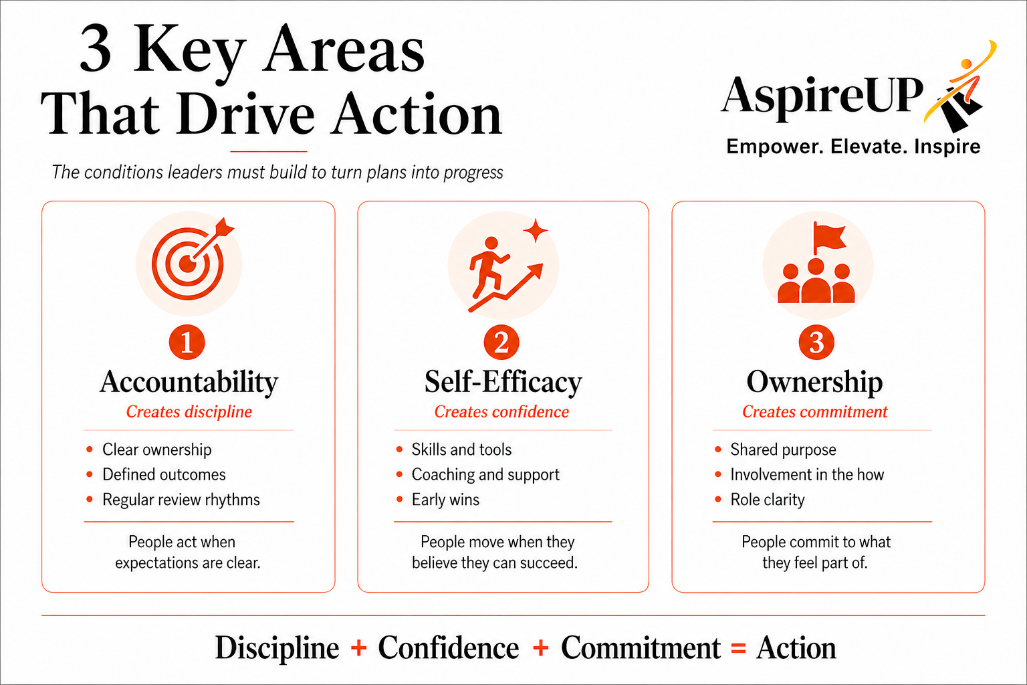
Research points to three conditions that matter most: accountability, self-efficacy, and ownership.
1. Accountability creates discipline
Accountability is often reduced to reporting, follow-ups, and performance reviews.
But real accountability is not about checking whether people are busy. It is about creating clarity around outcomes.
- Who owns the work?
- What does success look like?
- What decisions must be made?
- What progress must be visible?
Without this clarity, execution becomes vague. People attend meetings, discuss updates, and appear active, but little moves.
Leaders who drive execution make accountability visible. They establish clear commitments, define decision rights, create review rhythms, and make progress part of the team’s operating system.
Accountability should not feel like surveillance. It should feel like alignment.
2. Self-efficacy creates movement
Even when people understand the plan, they may not act.
The reason is not always resistance. Often, it is doubt.
People hesitate when they are unsure whether they have the ability, authority, support, or confidence to move forward.
This is where Albert Bandura’s work on self-efficacy is highly relevant. His research showed that people are more likely to act, persist, and perform when they believe they are capable of succeeding.
For leaders, this has a practical implication.
Execution is not only a planning challenge. It is a confidence-building challenge.
People need more than instructions. They need capability, coaching, tools, encouragement, and early wins that reinforce the belief: “We can do this.”
A team that lacks self-efficacy waits for direction. A team with self-efficacy starts moving.
3. Ownership creates commitment
Plans handed down from the top may create compliance.
They rarely create commitment.
Ownership emerges when people see themselves in the work. They understand the purpose, contribute to the approach, and believe their role matters to the outcome.
Research on psychological ownership shows that people are more committed to what they feel connected to. When something becomes “ours,” effort changes.
This is why leaders cannot afford to treat execution as a communication exercise.
It is not enough to announce the strategy.
Leaders must help teams interpret it, challenge it, localise it, and translate it into meaningful action. When people help shape the “how,” they are far more likely to commit to the “what.”
Ownership turns a plan from a leadership document into a team responsibility.
Execution is a leadership system
The common mistake is to assume that once a strategy is clear, action will naturally follow.
It will not.
Execution requires a system.
| Accountability | Self-efficacy | Ownership |
| Gives people discipline. | Gives people confidence. | Gives people commitment. |
When these three are missing, strategy becomes theatre. Teams talk about priorities, revisit the same issues, and mistake discussion for progress.
When these three are present, the behaviour changes. People decide faster. They act earlier. They recover quicker. They take responsibility for outcomes, not just tasks.
The real question for leaders, then, is not:
“Have we communicated the plan?”
It is:
“Have we built the conditions for people to act?”
Because the value of a strategy is never proven in the planning room.
It is proven in the quality of action that follows.
Research anchors
- Albert Bandura’s research on self-efficacy and human agency.
- Psychological ownership research by Pierce, Kostova, and Dirks.
- Leadership and execution literature on accountability, clarity, and performance rhythm.
AspireUP Consultancy | Empower. Elevate. Inspire
Written by : Dinesh Karna